SOHO event focuses on Kensington/Talmadge, Presidio Hills, Loma Portal

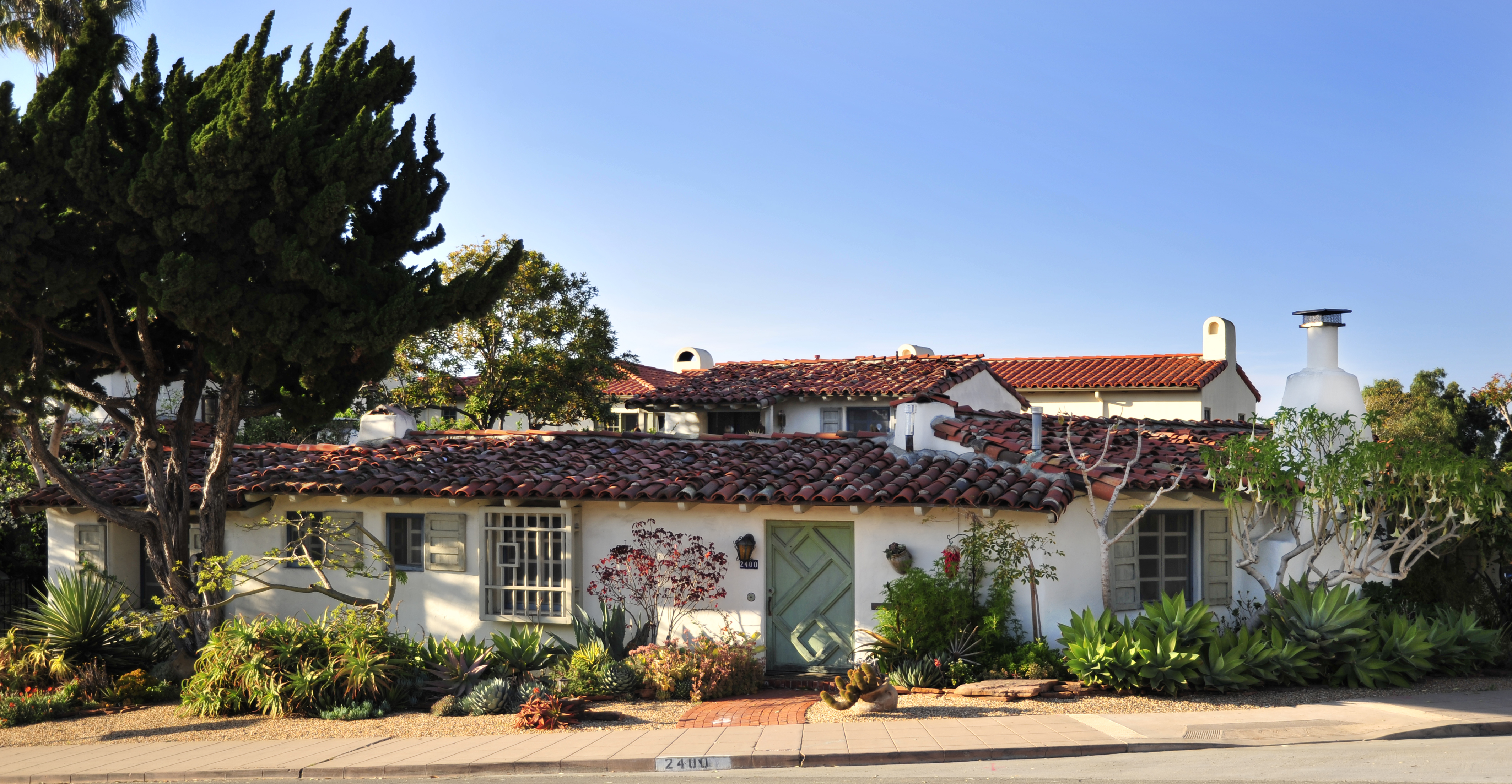
The Highland House, which hugs a prominent corner in Presidio Hills, was the first May-designed hacienda to be listed on the city of San Diego’s historic register.
By Alana Coons
Photos by Sandé LollisDesigner Cliff May’s earliest, hacienda-style homes from 1932 to1936 will be open together for the first time during Save Our Heritage Organisation’s annual Home Tour Weekend March 26 and 27.
The day-long, self-guided home tour on March 27 will invite visitors inside five rustic, adobe-like homes with multiple beehive fireplaces and large, walled courtyards in the historic neighborhoods of Talmadge, Presidio Hills and Loma Portal.
A classic home designed by May, a San Diego native who went on to be nationally known as “father of the ranch house,” will be the site of a cocktail party on March 26. On both days, SOHO’s Museum Shops at the Marston House and the Whaley House will feature select Spanish Revival and California Ranch House furnishings, period décor and books on architecture, preservation and do-it-yourself projects.
All proceeds from the Historic Home Tour Weekend benefit SOHO, San Diego’s largest preservation organization, in its advocacy and educational work to protect San Diego County’s historic architectural, archeological and cultural heritage, sites and landscapes. Founded in 1960, SOHO recently received a 2011 Governor’s Award for the documentary it produced on its history and role in San Diego’s preservation movement.
The colorful, little-changed haciendas on the SOHO tour demonstrate the impact of May’s own rancho roots on his vision and designs for casual, indoor-outdoor living in Southern California that eventually spread across the nation.
Visitors can retrace the first creative steps of the entrepreneurial May (1909-1989), a sixth-generation native San Diegan and descendant of the Estudillo family. He spent his youth roaming or riding around authentic Spanish-Mexican adobe homes, including his Aunt Jane Magee’s Rancho Santa Margarita y Flores, now part of Camp Pendleton, and La Casa de Estudillo, now in Old Town San Diego State Historic Park.
May, who was not trained as an architect, began his design career designing and making furniture. He completed his first several haciendas, which were spec houses, with furniture, hardware, lighting fixtures and landscaping he designed or selected to complement the rustic, faux-adobe architecture that recalled old California. A natural at marketing, May did this to spur sales during the Great Depression and to reinforce the historic pleasures of indoor-outdoor living in single-story homes that hugged the earth.
The tactic worked so well that May’s first hacienda — the Arthur J. and Frances O’Leary house (1932), which is on the tour — sold for $9,500 when its designer was only 23. Like May’s family homes, this U-shaped residence rambles around a large, walled courtyard, which is intended to be the main living room. Entry is through a rough-hewn front door, which leads to the courtyard. Passage into the house itself is from a veranda, or corredor, equipped with several pairs of French doors. With its roof providing protection from the sun and rain, the furnished veranda serves as transitional living space between indoors and out. The single-story house is built at ground level, making it seem like an old adobe rising out of the earth.
Word spread about the enterprising young May and his hospitable hacienda. He continued to build haciendas similar to the O’Leary House, but with modifications that visitors on the SOHO tour can trace for themselves. His second spec house in Kensington (the Captain and Mrs. William Lindstrom House, a National Historic Landmark, built in 1933 and another stop on the SOHO tour) also sold quickly with all its furnishings.
By this time, May had attracted the attention of the media and civic leaders. “Cliff May is one of the most interesting young men in San Diego,” begins a story published in The San Diego Union in 1933. It didn’t hurt that his future father-in-law, developer and real estate agent Roy C. Lichty, was one of his backers.
May received his first commission from Dr. John Beardsley, for whom May produced another hacienda (1933) with thick walls, red-tiled roof and heavy wood doors and window grilles in Loma Portal. Businessman and developer George Marston offered May a lot to build on in Presidio Hills, where the young man constructed another rambling hacienda (the Alex Highland House,1934) that hugs a street corner. Both of these homes are also featured on the SOHO tour.
Between 1932 and 1937, May designed about 50 courtyard haciendas in the San Diego area. He moved to Los Angeles in 1936, but retained close ties with his birthplace. His business and reputation took off in Los Angeles, where he developed the suburban ranch house in response to the great need for post-World War II housing.
During a career that spanned more than 50 years, May designed thousands of ranch houses, a modern version of the single-story hacienda with easy indoor-outdoor connections. These designs and the suburban lifestyle they represented were promoted by Sunset and other national magazines. He became so well known that Sunset published the book “Western Ranch Houses” by Cliff May, which combined May’s philosophy of living with architectural plans that were built throughout the country. He also designed custom homes for Hollywood clients such as Gregory Peck and Shirley Temple Black. His own home, Mandalay, became a showpiece. May was still working when he died at age 81.
For more information on the SOHO Historic Home Tour Weekend events and to purchase tickets, visit sohosandiego.org or call (619) 297-9327 or (619) 297-7511.
Sunday, March 20, 2011
Home Tour Celebrates Cliff May’s Classic Hacienda Style

Friday, March 18, 2011
WSPA Heads To Japan
WSPA prepares to head into Japan
©AFP/Getty Images Early tomorrow morning (local time) a WSPA Disaster Assessment and Response Team (DART) from the WSPA Asia office will depart for Japan, following days of monitoring the situation from afar and keeping up constant discussion with partner organisations within Japan.
Dr. Ian Dacre and Dr. Damian Woodberry, two WSPA vets with years of experience in operations to help animals in disasters, will start by signing up to join the ‘shelter cluster’ coordinated by the United Nations Office for the Coordination of Humanitarian Affairs (OCHA). As OCHA has stated in its Situation Report of 14 March, “search and rescue remains the priority in tsunami and earthquake affected areas”. Considering the large numbers of people that will need to be housed in temporary shelters, as we reported yesterday, we expect there to be a significant impact on the animals that were part of these families.
The WSPA team are also hoping to meet with contacts in the Japanese Ministry of Agriculture, Forestry and Fisheries MAFF) as well as the Ministry of Environment (MoE), who have already been informed of our willingness to support their efforts in the field.
Meanwhile we’ve received a very positive update from our member society the Kanagawa Society for Prevention of Cruelty to Animals (KSPCA); they inform us that several animal welfare groups in Japan have come together to launch a coordinated effort to help the animals affected by last week’s quake and resultant tsunami.
Being present in Japan will mean that the WSPA DART are able to extend more tangible support to these groups working in the field, who with their presence on the ground, have a far superior understanding of the needs facing animals in Japan right now

NAHB Identifies Top Counties for Home Remodeling
The National Association of Home Builders (NAHB) last week released a list of the top counties in the country prime for remodeling dollars.
At $9.4 billion, Los Angeles County, Calif., leads the list of counties spending the most money on remodeling. Rounding out the top five list is Cook County in Illinois, Orange and San Diego counties in California, and Maricopa County in Arizona.
The NAHB model uses data from the American Housing Survey, which is funded by the U.S. Department of Housing and Urban Development and conducted by the U.S. Census Bureau. The data helps NAHB estimate local remodeling based on home and homeowner characteristics. It’s then applied to the information on every county's homes and homeowners that the Census Bureau released late last year from its American Community Survey. The new NAHB estimates include remodeling spending per owner-occupied home.
"Total remodeling spending in a particular county is most strongly related to the number of home owners in the county," said NAHB Chief Economist David Crowe. "On the other hand, we found that remodeling per home depends upon factors such as the share built before 1980, the share owned by married couples, and, most significantly, the average value of the homes."
Nantucket County in Massachusetts leads the nation on remodeling spending per home at $9,369. Other counties in the top five include New York County (Manhattan) and three counties in the San Francisco metropolitan area. In each of these counties, remodeling is more than $8,000 per owner-occupied home. In comparison, the average across all counties nationwide is $2,085.
"Many remodelers are seeing increased interest from home owners on upgrading their home," said Bob Peterson, the NAHB remodelers chairman, and president of Associates in Building & Design Ltd. in Ft. Collins, Colo. "Investing in home remodeling brings the immediate satisfaction of enjoying a more comfortable dwelling, but can also support long-term home values."
The counties with the highest total estimated spending on home remodeling:
- Los Angeles County, Calif., $9.4 billion
- Cook County, Ill., $4.6 billion
- Orange County, Calif., $4 billion
- San Diego County, Calif., $3.4 billion
- Maricopa County, Ariz., $3 billion
The counties with the highest estimated spending per owner-occupied home:
- Nantucket County, Mass., $9,369
- Marin County, Calif., $8,755
- New York County, N.Y., $8,716
- San Francisco County, Calif., $8,443
- San Mateo County, Calif., $8,053
The National Association of Home Builders is a Washington-based trade association representing more than 160,000 members involved in home-building, remodeling, multi-family construction, property management, subcontracting, design, housing finance, building product manufacturing and other aspects of residential and light commercial construction. NAHB is affiliated with 800 state and local home builders associations around the country.
San Diego Maritime Museum - Ships from Different Seas, Centuries
SAN DIEGO - The bay is filigreed with all variety of Navy ships and pleasure craft. Since 2004, the decommissioned USS Midway - a 972-foot aircraft carrier - has been permanently in the mix.
But the coolest thing to board might be the Maritime Museum of San Diego: You can tour a multivessel collection in just a couple of hours and come as close as humanly possible to stepping into a Joseph Conrad novel, being with Russell Crowe in "Master and Commander" and getting a feel for Cold War submarine duty.
The Maritime Museum is walking distance from many downtown hotels and just a stroll up Harbor Drive from Seaport Village and other waterside attractions. By the time you reach the beautiful old Amtrak station, you'll be drawn to the enormous white sails.
That billowing sight is the Star of India, the museum's star attraction. The three-masted barque was constructed on Britain's Isle of Man in 1863 as the Euterpe, a wood-and-iron trader fit for the open seas. After a few hair-raising voyages - it was heavily damaged in a storm off the coast of India - the ship specialized in hauling people and freight from Britain to New Zealand.
It was built for speed, was never fitted with backup engines, and managed to hold its own while the sea lanes were increasingly dominated by motorized ships. Its fastest passage to New Zealand was 21 days.
Different adventures followed. Between 1900 and 1920, rechristened the Star of India, it hauled fishermen and supplies from Oakland, Calif., to the Bering Sea, returning with tons of canned Alaskan salmon. Having outlived its usefulness, it was acquired in 1926 by the organization that runs the San Diego Zoo in Balboa Park. After decades of decaying on the San Diego docks, the ship was restored and made seaworthy in 1976.
How seaworthy? It goes out two days a year - to keep its Guinness Book of Records status as "oldest active sailing ship" - manned by a volunteer crew.
The sails, unfurled from their masts and rising 21 1/2 feet, gleam in the sun; the rigging looks fresh and tight; the wooden decks scrubbed, the wheel and capstan polished. The stairway down from the main deck has a Victorian elegance, and the officers' polished-wood quarters and mess area have the feel of a floating B&B, not a rough-and-tumble freighter.
The good looks can be deceiving, though. The below-deck hold, devoid of cargo or passengers, doesn't convey how much the ship could transport nor how miserable life was for people packed like cattle on their long voyage to a new land.
But knowledgeable volunteers who swarm this ship and the others here are quick to tell you all you need to know and then some.
The dock to the Star of India takes you past the HMS Surprise, the full-size replica of a 24-gun British frigate that dates to the Napoleonic Wars. It was built in Nova Scotia in 1970 and eventually became a U.S. Coast Guard training vessel and PR photo op on the East Coast.
Decades later, it was spotted by 20th Century Fox, which bought it and sailed it to Southern California through the Panama Canal when the studio was laying plans for filming "Master and Commander: The Far Side of the World," based on the swashbuckling best-sellers by novelist Patrick O'Brian..
The main deck is the star - where Captain Jack Aubrey (Crowe) and others headed when scenes called for all hands aft. The obligatory figurehead perches on the prow; the ship's name is boastfully painted in gold on the stern. Walking it from end to end, below shadows cast by the sailcloth and webs of rigging, your imagination is ready for adventure.
Which is more than the ship physically is. The HMS Surprise floats but does not sail.
Boarding the B-39 Soviet submarine is different. You must pass through a Hula-Hoop-size opening to gain entrance: Space on the early '70s attack sub is so limited that the museum can't risk tubby tourists getting stuck.
The sub was decommissioned in 1994 and passed through Finnish and Canadian hands; a decade later it ended up here.
You don't realize how short 300 feet can be until you climb down the hatch into a slim thicket of pipes, wires, levers and spigots - it resembles a dingy clarinet turned inside-out. Torpedoes with "CCCP" (translation from Russian: USSR) line the sides, with work stations and bunks wedged here and there. This sub was diesel-electric powered, so it had that diesel odor and was louder than heck inside.
It was considered large in its day, but with 24 torpedoes and a crew of 78, every space was in use. The captain and the political officer had private cabins, each the size of a coat closet. Common seamen shared "hot bunks": When you woke up to start the workday, a crew member coming off duty would take the bed you kept warm. Only the paper sheets were changed occasionally.
The B-39's Foxtrot class was made outdated by the Soviet's Typhoon-class subs - the ones in the Tom Clancy novel-turned-movie "The Hunt for Red October." But subs like this one were front and center in Clancy's "Red Storm Rising" novel.
Thursday, March 17, 2011
Renew Your Lease - Rents Could Rise 10%

Already, rental vacancy rates have dipped below the 10% mark, where they had been lodged for most of the past three years.
"The demand for rental housing has already started to increase," said Peggy Alford, president of Rent.com. "Young people are starting to get rid of their roommates and move out of their parent's basements."
By 2012, she predicts the vacancy rate will hover at a mere 5%. And with fewer units on the market, prices will explode.
Rent hikes have averaged less than 1% a year over the past decade, according to Commerce Department statistics, adjusted for inflation. Now, Alford expects rents to spike 7% or so in each of the next two years -- to a national average that will top $800 per month.
In the hottest rental markets, the increases will likely top the 10% mark annually for the next couple of years, according to Lesley Deutch of John Burns Real Estate Consulting. In San Diego, she anticipates rents will rise more than 31% by 2015. In Seattle rents will climb 29% over that period; and in Boston, they may jump between 25% and 30%.
This is a sharp change from the recession, when many Americans couldn't afford to live on their own. More than 1.2 million young adults moved back in with their parents from 2005 to 2010, said Deutch. Many others doubled up together.
As a result, landlords had to reduce prices and offer big incentives to snag renters.
Now that the recession is easing, many of these young people are ready to find new digs, mostly as renters, not owners. Plus, the foreclosure crisis continues unabated, and the millions losing their homes are looking for new places to live.
Apartment developers many not be able to keep up with this heightened demand, which will force prices upwards, according to Chris Macke, a real estate analyst with CoStar, which tracks multi-family housing trends.
"There will be an envelope of two or three years," said Macke, "when the rise in demand for rentals will exceed the industry's ability to meet it."
Plus, Alford added, "there's been a shift in the American Dream. We're learning from our surveys that a huge proportion of people are choosing to rent."
They've experienced the downsides of homeownership -- or seen friends and family suffer -- and don't want to take the risks or pay the higher costs of homeownership.
Where homeownership costs are particularly high, there are many more renters than owners. In Manhattan, for example, only about 20% own their homes; in San Francisco, about of third of the population does; in Los Angeles, less than 40%; and in Chicago, about 44%.
There's one factor that could rein in rent increases: the huge number of foreclosed homes that could hit the market over the next few years.
In many markets, like Phoenix and Las Vegas, there are neighborhoods filled with recently built, single-family homes going for fire-sale prices. When the cost of owning homes falls well below the costs of renting them, more people will buy.
"That's always been the biggest competition for rentals," said Deutch.
courtesy of: http://money.cnn.com/
San Diego Home Prices Up Very Slightly in Feb 2011
February’s median price for all homes inched up to $308,000 from $304,000 in January. However, the median price fell 4.3 percent from $322,000 a year ago. The median price for single-family homes, comprising the bulk of the county’s inventory, decreased 0.7 percent in February from January, indicating a flattening of the market.
San Diego County recorded 2,330 sales in February, up from 2,248 in January, or 3.6 percent. Transactions were down 5.5 percent from one year ago.
DataQuick analyst Andrew LePage said February’s monthly increase in sales and flat prices can be attributed to a high volume of short sales and foreclosures.
About 55 percent of February’s resales, including single-family homes and condos, were distressed properties, LePage said. Thirty-four percent were foreclosures (up from 32.8 percent in January,) and an estimated 21 percent were short sales (about the same amount as January).
One year ago, distressed properties made up about 59 percent of resales in the county.
Short sales — deals in which the sale price was less than the mortgage balance — have risen sharply in the last three years, DataQuick numbers show. One year ago, they accounted for 20.5 percent of resales in the county. In 2009, it was 15.7 percent.
“They’re increasing by a lot,” LePage said. “If processing foreclosures gets a lot more expensive, then we should expect a lot more short sales and loan modifications.”
Also notable was that 30.6 percent of the homes sold in February were purchased with cash, a record high for the county, according to DataQuick figures, which go back to 1988.
Absentee buyers, people who likely will not occupy the purchased homes, bought a record 28.3 percent of the properties in San Diego County in February, DataQuick reported. In the past decade, that average number was about 16 percent. (The company’s records for absentee purchases start in 2000.)
Mortgage Rates Fall for 5th Consecutive Week
Mortgage rates fell for a fifth consecutive week nationwide last week, according to Zillow.com, which has been tracking mortgages since April 2008.
Zillow, which determines average mortgage rates based on custom mortgage quotes submitted daily through its website, found the average rate on a 30-year, fixed-rate mortgage is 4.58 percent, down from 4.71 percent a week ago.
The average rate for a 15-year mortgage is 3.77 percent, down from 3.99 percent. A 5-1 adjustable-rate mortgage is averaging 2.99 percent, down from 3.25 percent.
